I Applied to QWS Challenge and Was Rejected — The Question: "Is the Shape of That Tool Really 'Optimal'?"
Overview
This is a membership program at SHIBUYA QWS, located in Shibuya Scramble Square.
Rather than requiring a fully polished product, this contest focused on “what you want to do” and “what question you are pursuing.” The application form reflected exactly that:
- Describe your project’s question
- Through what experiences was your “sensitivity to questions” cultivated?
- What unknown value do you believe your question leads to?
No specs, no revenue figures, no technical difficulty — none of that was asked. It was a completely different flavor from anything I had applied to before, and it took me the longest to write.
The result was rejection.
Below I reproduce, nearly verbatim, what I actually wrote in the application form.
Project Title
Is the Shape of That Tool Really “Optimal”?
The Question
Is that tool truly in its most optimal form? That was my initial question.
When we play games, we use tools such as controllers, keyboards, and mice. The profession of “professional gamer” — people who use these as their work instruments — has become commonplace. Of course, the tools each player uses differ. The goal of operating the game remains the same, but response speed, ease of pressing, and overall feel all vary.
Yet the general shape of these tools has barely changed over the years. The clearest example is the keyboard. A keyboard was originally a machine for entering text; it was not designed like a controller, shaped for playing games. When I thought about this, I began to wonder: is this tool truly optimal? Is there not a more optimal form?
Overview
It starts by questioning the shape of the tools we take for granted every day. Using that question as a starting point, I am developing — and actually bringing to market — a keyboard aimed at the truly “optimal form” for each user’s purpose.
That said, something that departs too radically from the current form will not be accepted easily. So the first domain I tackle is “gaming” — the field where people are most particular about their tools. I begin by observing products that the market has accepted, and by introducing an improved version of the mechanism that has become the de facto standard.
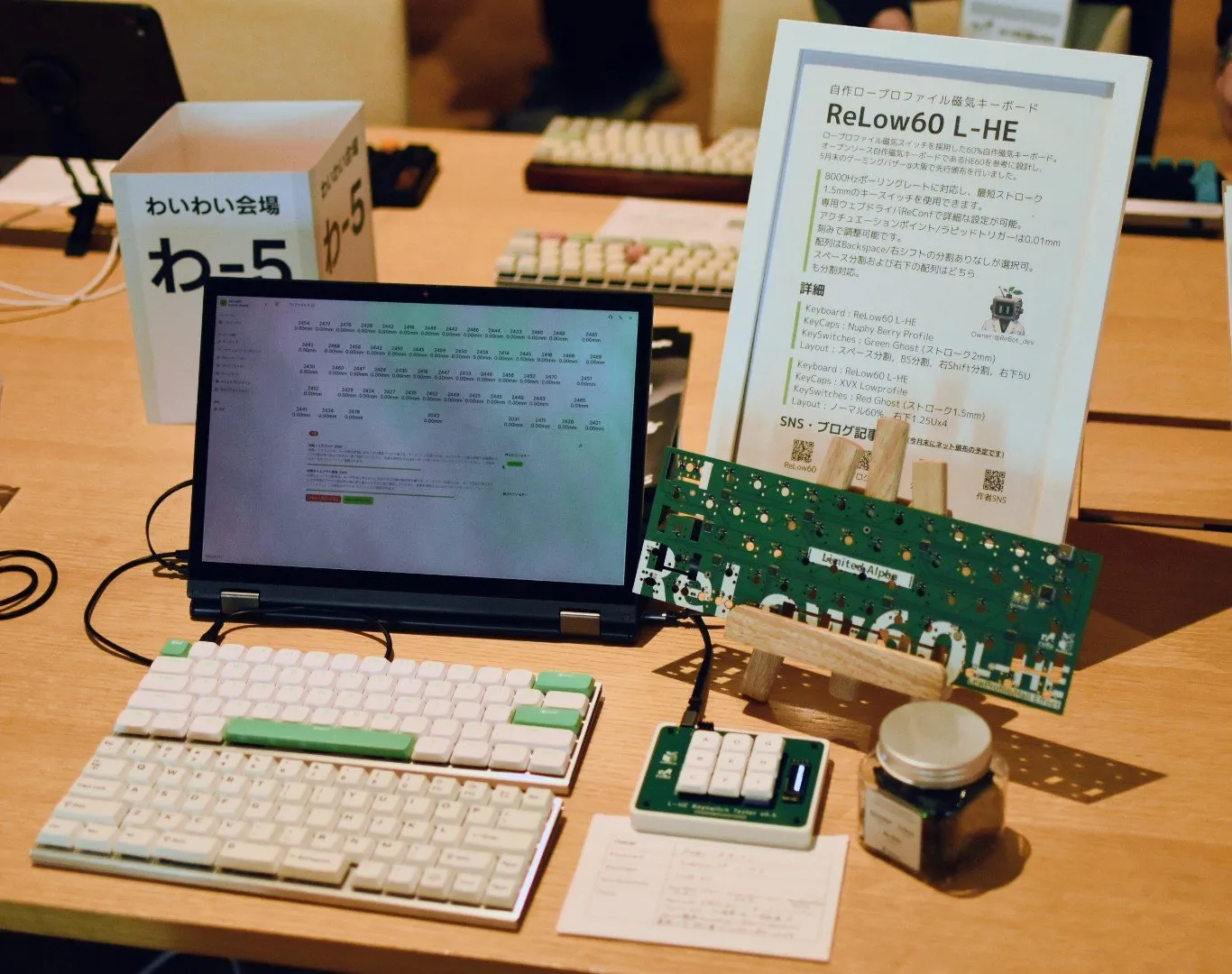
Concretely, this means a keyboard that reads key input using magnets and has a shallower keystroke depth. In this approach, the magnet inside moves in response to how far a finger presses down, and the change in magnetic force detects the input. Because it can react faster than traditional metal contacts, this method is spreading. Yet the keystroke depth itself has barely changed from the era when contact-based switches were mainstream.
The detection mechanism is new, but the form remains old. This contradiction is the specific entry point for the first “optimization” I address.
Reason for Applying — Why I Want to Work at QWS
I have been developing products independently and exchanging ideas within communities of keyboard and gaming device enthusiasts. However, I have noticed a challenge: evaluation criteria there tend to skew toward limited metrics like response speed and typing feel, and the perspective stays closed within “people who already use this tool well.”
The question of whether a tool is truly in its optimal form can only deepen by incorporating the perspectives of people who do not normally play games or who use their bodies differently. Learning that QWS brings together diverse players across ages and specializations, I believed that here I could re-examine my question from different angles and intersect it with unexpected friction and insights.
How My “Sensitivity to Questions” Was Cultivated
I have always enjoyed searching for things that suit me. With tools in particular, there is the dimension of “ease of use.” Breaking that down, there are many metrics: whether the tool correctly addresses its intended purpose, whether extended use puts strain on the body, whether durability is assured, whether it has versatility — and concretely, whether it improves work efficiency, raises game scores, or lowers maintenance costs.
I have evaluated products from this perspective and chosen what I felt suited me best. As I advanced this analysis, I inevitably ran into things I wanted but that did not yet exist on the market, or cases where demand was too niche for companies to enter. In those cases, I also took to making the tool myself.
I believe this cycle of analysis and optimization connects to the question at the heart of this project, and to the challenge of building it myself.
What I Want to Accomplish at QWS Concretely
At this point, I have progressed to designing PCBs and prototyping cases for a short-stroke keyboard using magnets, and have reached the stage of putting a limited run into the world. On the other hand, evaluation of feel has relied on my own sense and that of the surrounding community.
At QWS, I first want to use CROSSTAGE to have a broad range of Shibuya Scramble Square visitors physically try the prototype, and to collect data on hand movements, pressing habits, and responses to feel.
I also want to put the question “Is this tool in its optimal form?” on display and draw out the friction and doubts that people who do not normally play games experience. The diverse responses gathered that way I intend to read through both a technical engineering lens and a non-engineering lens focused on the body and actions of the user, then feed those readings into the next prototype.
What Unknown Value It Leads To
Not only for optimizing games — for people who type text, draw illustrations, or live with physical constraints on how they move their bodies — those who have long accepted “a keyboard looks like this” and moved on will be able to choose the very form of their input tool to suit their own purpose and body. That is the value I believe this leads to.
Why now? Because in recent years the switching mechanism has evolved, and input detection is being liberated from the traditional physical constraints of how deeply a finger must press. That is precisely why we have arrived at an inflection point where we can ask, “Why does a keyboard have this shape?”
First, among the people most particular about their tools — gamers — I will put a new form that minimizes finger movement into the world. From there, I will spread the insight that “the shape is allowed to change” beyond gaming into other contexts.
This is not simply a story of building one fast-responding keyboard. It is a shift in the premise itself — that the form of an input tool is not fixed, but can be questioned from the acts of the person using it. Doubting the shape that everyone now accepts as a matter of course, I believe, is the entry point to an optimal solution no one has yet noticed.
In addition to the above, I also submitted an activity record and a pitch video.
Reflections After the Rejection
I was rejected. I genuinely wanted people in Shibuya — including those who do not normally play games — to try the prototype, so that part is honestly disappointing.
That said, the question I articulated for this application — “Is the shape of that tool really ‘optimal’?” — is one I have kept using ever since. The presentation for TiB FAB Makers Challenge opened with almost exactly this question, and I also used it to explain my design philosophy during the dialogue for an AI utilization grant program. Both of those were accepted.
The text written for a rejected application ended up supporting the ones that got through. Facing a form that asked nothing about product specs forced me, for the first time, to properly put into words what I am actually trying to build.
A summary of TiB, AI utilization grant, DigiKey, and QWS
Low-profile magnetic switch keyboard